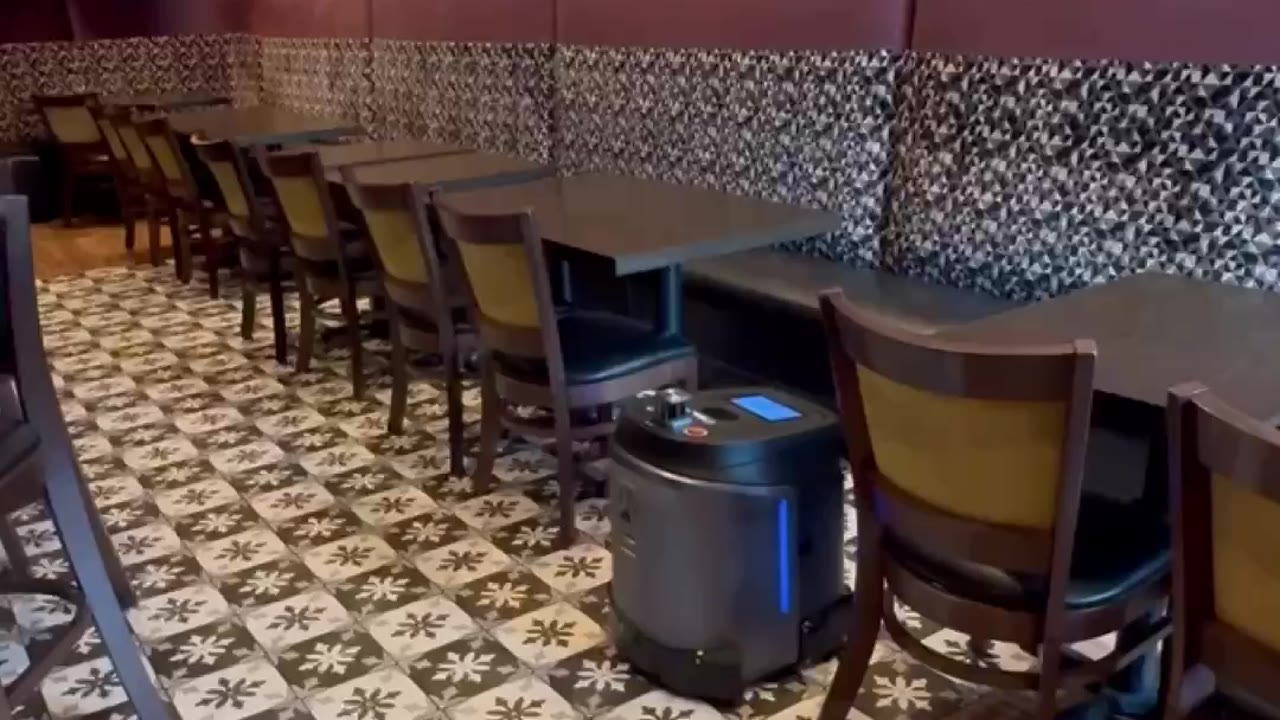
Robots that carry food and dishes for Houston restaurants, so your servers can remain with your guests.
Serving robots carry dishes from the kitchen to each table and return used tableware to the dishwashing area. Cleaning robots maintain the floors after closing, and our team in Stafford, TX, installs, configures and services each robot we deploy.
Because 100% bonus depreciation is now permanent, robots placed in service in 2027 may also qualify.
To speak with our team directly, call RobotLAB Houston at (281) 357-9188.
Floor cleaning
Floor cleaning: a cleaning robot working in a Houston restaurant
Daily operations
Routine tasks that repeat every service day.
Throughout every service, your staff carry food to tables and return used dishes to the kitchen. After the last guest leaves, the same team must clean the floors.
Labor costs
Every trip to a table and every hour of floor cleaning is paid labor.
Delays can occur daily: plates wait at the kitchen counter, and used dishes accumulate while guests wait for a table. At closing, paid staff time is spent cleaning floors. Robots can take on the carrying and the floor cleaning, and you decide whether those hours return to guest service or are saved.
Robots handle the carrying; your team attends to guests.
We design each deployment so that robots take on the repetitive walking while your staff remain focused on hospitality.
Robot
Tasks for the robot
Food delivery: carrying dishes from the kitchen counter to each table.
Dish return: carrying empty plates and dish bins to the dishwashing area.
Floor cleaning after closing: the dining room, bar and walkways, on a set schedule.
Host stand (optional): escorting guests to the table selected by your host.
Kitchen counter
People
Tasks for your team
The welcome: a member of staff remains at the host stand.
Table service: taking orders, making recommendations, checking on guests and serving drinks.
Very hot dishes, and any item you prefer your staff to carry.
Any guest who prefers to be served by a person.
Food delivery and dish return · Serving robots
How a serving robot delivers food and returns dishes.
Staff load a Pudu serving robot at the kitchen counter and send it to the table, sparing your servers the repeated walk from the kitchen.
Several tables in one trip
Plates for several tables can be loaded at once, and the robot stops at each table in turn.
Returns used dishes
Empty plates and dish bins return to the dishwashing area with the robot, which reduces the trips needed to clear tables.
Summoned by pager
Staff can call the robot back to the kitchen counter with a pager whenever the next order is ready.
Configuration · Serving robot
Trays
Multiple trays per trip; the number of trays and the load limit depend on the model we recommend
Aisles
A minimum clear width applies, and we measure every aisle against the recommended model
Speed
Adjustable, and set to suit your dining room and your menu
Charging
A charging position outside guest walkways and wheelchair routes
Limit: bowls and glasses may be carried on the trays, but very hot dishes remain with your staff.
Dining room
Dining room of a Houston restaurant · Aisle widths are measured during the site assessment
After closing · Overnight cleaning
Floors cleaned after closing.
Once the last guest has left, cleaning robots begin at the time you set. They clean the dining room, the bar and the walkways that lead to the kitchen.
Closing can take less time. Your staff wipe tables, stack chairs and secure the premises, while the robot cleans the floor on your schedule.
CC1 Pro · Phantas
Pudu CC1 Pro and Gausium Phantas · Houston restaurant
Hard floors and carpet
Pudu CC1 Pro
4 cleaning functions in 1 unit: it sweeps, scrubs, vacuums and dust-mops, and on carpet it vacuums only.
Cleans approximately 7,500 to 10,800 sq ft per hour
Scrubs for up to 5 hours per charge and requires a clear path about 27½ in wide
Automatic water refilling requires the optional station.
Between tables · Low noise
Gausium Phantas
Scrubs or vacuums for up to 4.5 hours and dust-mops for up to 10 hours per charge
Cleans approximately 3,800 to 7,500 sq ft per hour in typical use and recharges in about 2 hours
Quiet mode operates at 60 dB or less, and the robot fits through a gap of about 25½ in (650 mm)
The Phantas is designed for hard floors.
Large spaces
Pudu MT1
Designed by Pudu for large areas of up to approximately 1 million sq ft
A cleaning path about 27½ in (700 mm) wide, a 35-liter (about 9-gallon) bin and an optional station that empties the bin
Recommended for patios, parking areas and banquet halls.
Host stand · temi (optional)
Support at the host stand while your host seats guests.
As an optional addition, temi displays your menu to waiting guests while your host remains at the stand. It can also escort a party to the table your host has selected.
Escorts guests to their table
Once your tables are saved as locations, temi can escort a party across the dining room.
Menu and specials on screen
Its 13.3-inch screen can display your menu and daily specials, and temi can answer common questions by voice (in English only).
Managers by video call
Through the video-call feature, a manager can appear on the screen at the entrance without leaving the office.
Standard features · temi
Modes
Guide, Delivery, Ads (advertising) and Telepresence (video call)
Hardware
13.3-inch screen · tray rated to about 6½ lb · up to 8 hours of operation · laser (LiDAR) navigation
Custom applications (quoted on request)
Features beyond the standard set, such as a wait-time display, require a custom application built with temi’s software development kit.
temi · Guiding guests
temi guides guests through a lobby and a retail store
Complimentary site assessment · Before any quotation
Assessing the fit for your restaurant.
During the site assessment, we evaluate 6 factors, and we will advise you if any area of your dining room is unsuitable for a robot.
Aisle width
Each serving robot requires a minimum clear aisle width, so we measure every aisle from the kitchen counter to the farthest booths.
Wheelchair routes
Wheelchair routes must remain at least 36 in wide, so charging and waiting positions are placed outside them. This is not legal advice.
Steps and ramps
Steps, steep ramps and high door thresholds require careful assessment, so we inspect each one along the planned route.
Carpet
We map every carpeted area because, on carpet, the CC1 Pro vacuums only and does not scrub.
Wi-Fi
We test the Wi-Fi signal along every route and identify weak areas to be resolved before the robot begins operating.
Table map
We record table numbers, the route from the kitchen counter, charging positions and any areas the robot must avoid.
What determines the cost, and what the quotation includes.
Cost depends on the number of robots, your floor plan and the payment option you select: purchase (with cash or financing), lease or Robots-as-a-Service (RaaS). For that reason, we do not publish prices; you receive a written quotation after the site assessment.
The recommended robots, with the cost of each payment option shown side by side
Mapping and configuration: table numbers, routes and charging positions
Training for servers, hosts and closing staff
The service plan: local support and maintenance from our team in Stafford, TX
Any site requirements identified during the assessment, such as a Wi-Fi improvement or a small ramp
Restaurant formats
Restaurant formats suited to these robots.
Dining room
Full-service and casual dining
Large dining rooms with many tables mean a long walk from the kitchen to the rear booths.
Refills
Hot pot, Korean barbecue and buffets
Refill plates go out continuously, and stacks of empty plates return to the kitchen throughout service.
Events
Banquets and catering
Many tables must be served at the same time, and a large room must be cleaned once the event ends.
Hotels
Hotel restaurants and events
A breakfast buffet, a restaurant and event rooms often share one building, and each of them has floors to clean.
Office, school and hospital dining facilities combine tray returns with large floor areas to clean.
Groups
Restaurant groups
A group can evaluate robots at one location and then apply the same configuration and training across every location.
Your figures · Labor-hours estimator
The labor hours robots could take on.
Adjust the sliders to reflect your daily food-running and bussing hours. The estimate shows its formula, the annual hours that robots could take on and the wages those hours represent.
Your restaurant’s figures5 inputs
12 hours
Total staff hours across all shifts
0 hours60 hours
8 hours
Total staff hours across all shifts
0 hours60 hours
6 days
1 day7 days
50%
The site assessment establishes the actual figure
10%90%
$15.00 per hour
$2$40
Hours robots could take onEstimate
Based solely on the figures you select.
Step 1 · Hours per year
3,120hours
(12 food-running + 8 bussing) hours per day × 50% × 6 days per week × 52 weeks
Hours and dollars saved. This is a simple calculation based on your figures, not a quotation or a guarantee, and it excludes the cost of the robots, service and financing.
Process · 5 steps
From the site assessment to ongoing service.
Installation typically takes from 4 hours to a few days, depending on the complexity of the integration. We map the dining room, configure the tables and complete testing before the robot enters service.
First visit
Complimentary site assessment
We review the dining room with you, including the layout, aisle widths, table map, door thresholds and the route from the kitchen.
In writing
Written plan and quotation
The plan sets out the recommended robots, tasks and routes, together with options to purchase (with cash or financing), lease or subscribe through RaaS.
On your floor
Mapping and configuration
The robot maps the dining room, and we then add and test table numbers, routes, charging positions and areas to avoid.
With your team
Training
We provide hands-on training for servers, hosts and closing staff in loading trays, dispatching the robot to tables, pausing it and charging it.
Ongoing
Local service
Our team in Stafford, TX, provides ongoing support and service after installation.
Year-end deadline · December 31, 2026
For a complete 100% deduction on a 2026 federal return, robots must be placed in service by December 31, 2026.
December is a demanding month for restaurants with holiday events. We therefore recommend scheduling the site assessment early. The installation date is confirmed after the site assessment, and we cannot guarantee completion by December 31.
The 2026 deadline has passed. Because 100% bonus depreciation is now permanent, we are scheduling installations for 2027.
Time remaining to place robots in service for the 2026 tax year
Robots in service by December 31 may qualify for a 2026 deduction.
100%
Bonus depreciation or Section 179
Robots that you purchase outright or finance, and that are placed in service by December 31, 2026, may qualify for 100% bonus depreciation. Under the 2025 federal tax law, this deduction is now permanent for qualifying equipment acquired after January 19, 2025. Section 179 is a separate option, with a 2026 limit of $2.56 million that phases out once equipment purchases exceed $4.09 million. A Section 179 deduction also cannot exceed your business income for the year. IRS Notice 2026-11 · IRS Rev. Proc. 2025-32 · IRS Publication 946
Taxable income is required
A deduction reduces your 2026 tax only to the extent that it offsets 2026 taxable income. If your business expects little or no profit, RaaS may be the more suitable option.
RaaS
RaaS payments are generally deductible as a business expense when paid. Bonus depreciation and Section 179 are available only to the owner of the equipment, so subscriptions and operating leases generally do not qualify.
Financing
Purchases may be financed through our banking partners, subject to credit approval, and a financed purchase can still qualify for the deduction.
Example · 2026 federal returnFederal estimate
$50,000
The amount shown is an example, not a robot price. If you have a written quotation, please set the slider to its total. The slider moves in steps of $500 up to $50,000, $1,000 up to $250,000 and $5,000 above that.
$2,000$1,000,000
21%
For example, 21% for a C-corporation; owners of pass-through businesses pay their individual rate of 10% to 37%.
10%37%
Deduction on the 2026 return, if the equipment qualifies$50,000
This example is federal only, because Texas has no state income tax. The Texas franchise (margin) tax is assessed separately; your accountant can advise how it applies to your business.
All figures are examples only and are not a robot price; any saving depends on your tax rate and your 2026 taxable income. This information is general and is not tax advice. Please confirm your eligibility with your tax advisor.
Questions
Frequently asked questions about restaurant robots.
Our guests value personal service. How will they respond to a robot?
Many guests value personal service, which is why the robot carries plates and used dishes while your servers remain at the table. Any table that prefers a person can be served entirely by your staff.
Will a robot replace our servers, and how might it affect tips?
The robot is designed to carry plates, not to replace your servers, who remain the people your guests speak with. We make no claim about any effect on tips.
Our aisles are narrow. Can a serving robot pass through them?
Each serving robot requires a minimum clear aisle width, and wheelchair routes must remain at least 36 in wide. We measure every aisle during the site assessment and will advise you if any area is unsuitable.
Will a robot reduce our costs?
The answer depends on your restaurant, so we review your actual labor hours during the site assessment before preparing a quotation. The labor-hours estimator on this page provides a preliminary figure.
How long does installation take?
Installation may take up to several weeks, from the site assessment and placing the order to the delivery of the robots to your facility. On-site installation itself typically takes from 4 hours to a few days. If you would like robots in service by December 31, we recommend scheduling the site assessment early.
Can the robot carry hot soup and drinks?
Bowls and glasses may be carried on the trays, and we set the robot’s speed to suit your menu. Very hot dishes remain with your staff.
Our business did not make a profit this year. Would the deduction still help?
A deduction lowers tax only when there is taxable income to offset. Without a profit, RaaS may be more suitable, because it requires no purchase. RaaS payments are generally deductible as a business expense when paid.
Can the robots handle carpet and door thresholds?
Steps, steep ramps and high door thresholds require careful assessment, so we inspect each one and every carpeted area during the site assessment.
Is Wi-Fi required?
Wi-Fi is required for setup, software updates and some features. We test the signal along your routes and identify weak areas to be resolved before the robot begins operating.
When do the cleaning robots operate?
They typically clean after closing, on your schedule, once the dining room is empty. We plan their routes around the order in which your closing staff leave the room.
Can we purchase, lease or subscribe through RaaS?
Yes. Each option is available, and a purchase may be financed through our banking partners, subject to credit approval. Purchased or financed equipment may qualify for 100% bonus depreciation or Section 179, while the tax treatment of a lease depends on its terms. After the site assessment, you receive every option in writing.
How does the Texas franchise tax apply?
Texas has no state income tax. The Texas franchise (margin) tax is assessed separately; your accountant can advise how it applies to your business.
Complimentary site assessment
Schedule a complimentary site assessment.
Please provide a few details and select a time for a complimentary 30-minute consultation. During the consultation, we plan a site assessment at your restaurant, covering routes, aisles and the tasks to automate first. Following the assessment, you receive a written plan and a written quotation.
OfficeRobotLAB Houston, 3727 Greenbriar Drive, Suite 404, Stafford, TX 77477. Demonstrations, installation and service are provided from this office.
30-minute consultationLive calendar
About the figures on this page. All estimates are illustrations based on the figures you select, and actual results depend on your floor plan, menu and team.